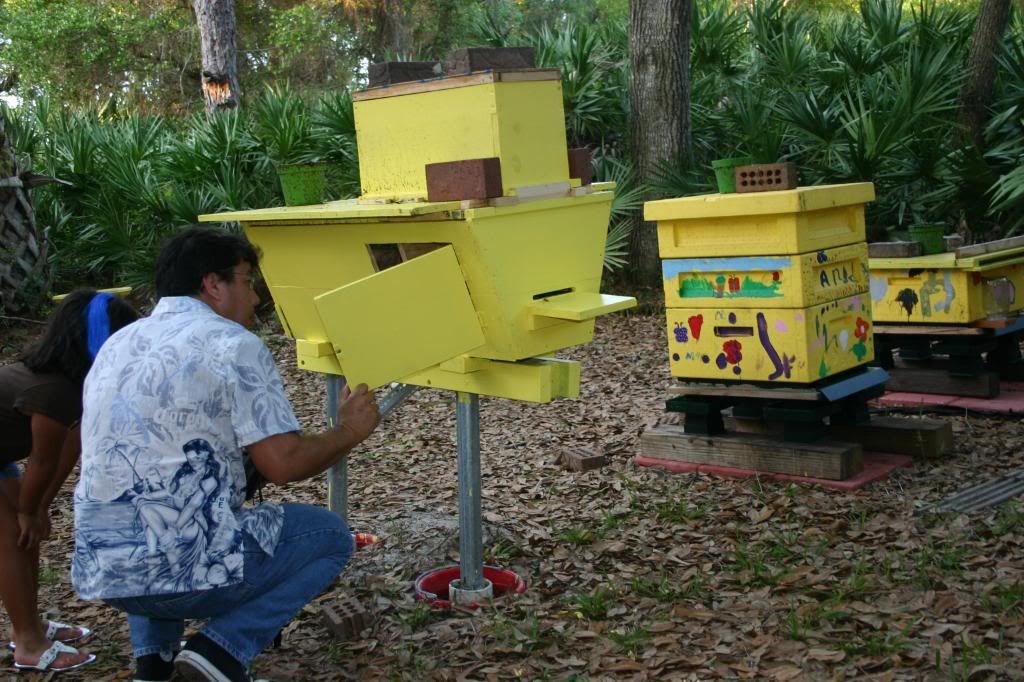
 From right to left; my empty ten frame deep hive, just in case my main hive decides to swarm, I hope they go there. Mike purchased some swarm bait (Lemon oil, I swear it smells like wood furniture polish), and he let me have a few q-tips soaked in it. I used two to bait the hive. In Florida we need to be aware about African honey bees. There is no difference in behavior of swarms between European or African honey bees, so they can pose a deadly danger. My best and safest scenario are the two 3lb packages on order due to arrive early May; if no one moves into the empty hive one of these packages will get installed in it.
In the middle is my main hive. The bees decided to supersede the queen, ever since there have just been small amounts of eggs. The honey flow has begun, and instead of being up to strength or growing, the hive has been declining. I popped off the top today. There were a handful of bees working the supper, and more of the frames have been drawn out. Definitely not close to the strength it was before the split. An inspection on the 1st week of May should reveal a new laying queen. Sometimes I wonder if they swarmed, aside from the diminish number of bees signs don’t point towards that.
Finally on the left the Top Bar Hive with the Nuc sitting on top of it; this hive is slowly captivating more and more of my attention. I think it might be the fact that I build it myself. I’m waiting for the bees to decide to move down so I can remove the Nuc. The kids and I enjoy taking a peek now and then via the inspection window. The number of bees in the TBH cavity increases daily, but I still have not observed any work been done on the foundation or the top bars.
Below is the view into the TBH. The Boardman feeder can be seen behind the follower board. The bees are no longer taking any sugar syrup.  On the other side of the follower board are eight strips of wax foundation, and the hollowed out 1st Top bar that allows the bees to move up into the Nuc cavity.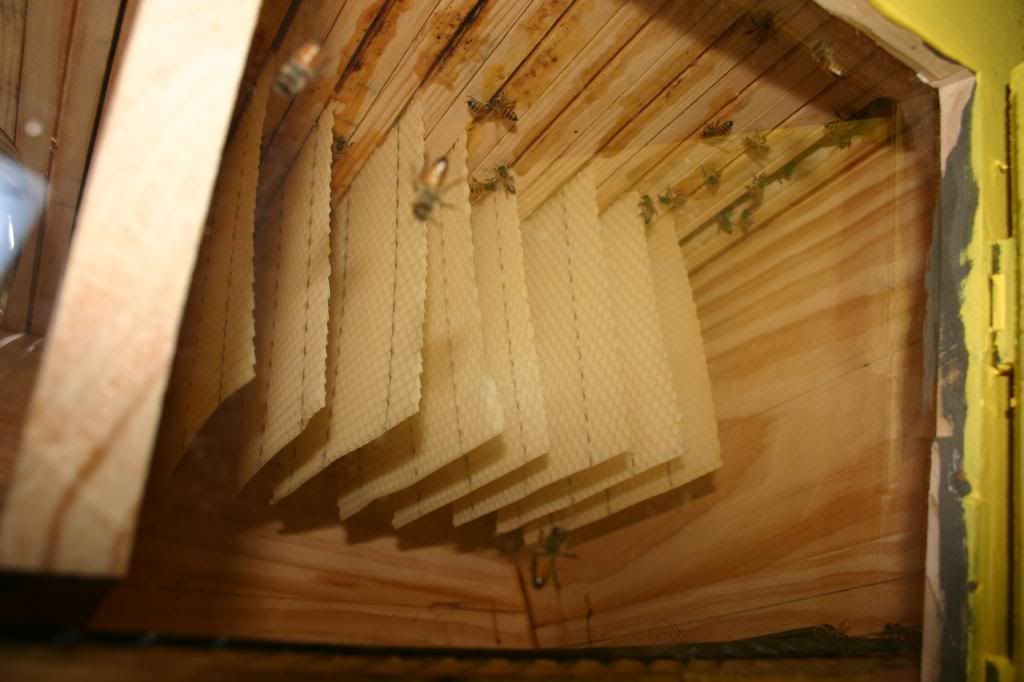
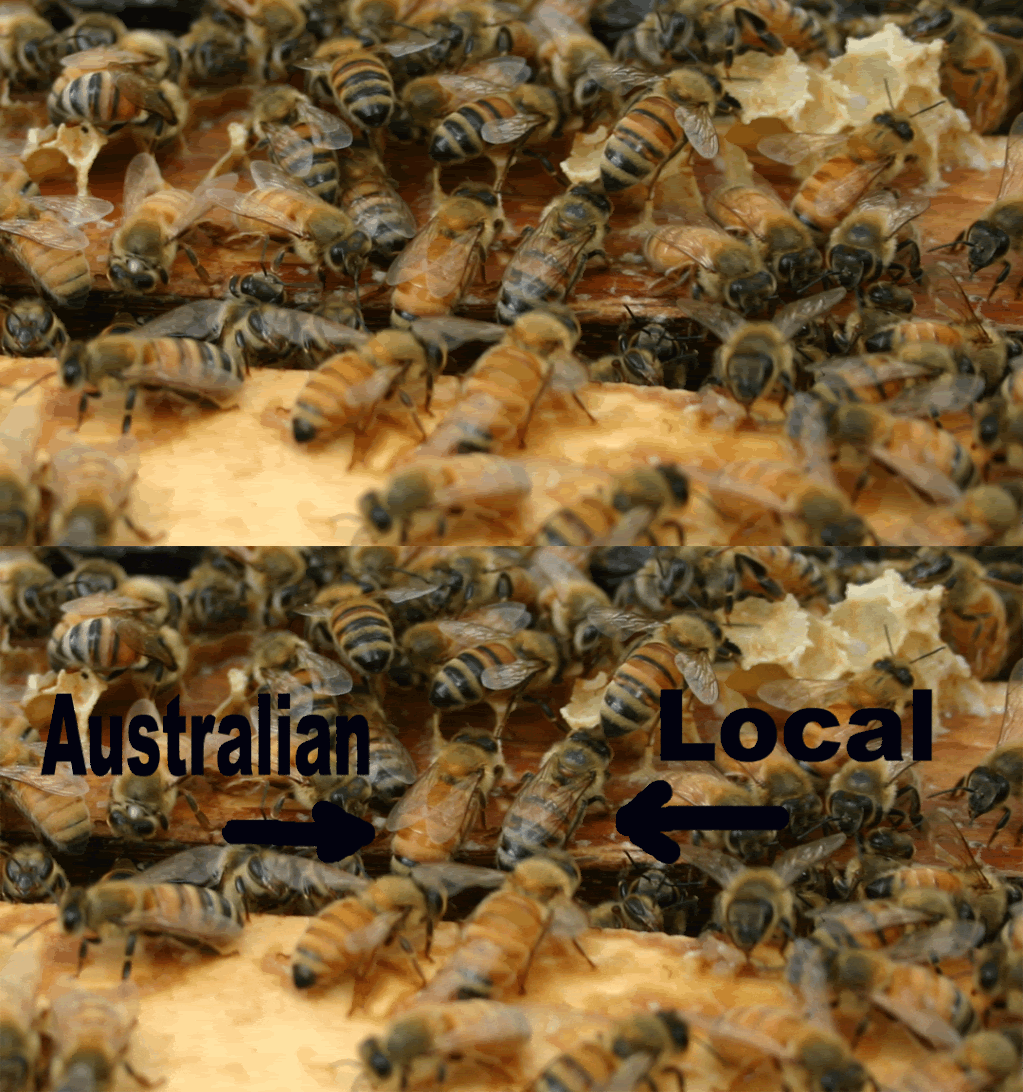
I decided to pop the top off the Nuc for a quick inspection. I didn’t pull any of the frames out; I didn’t feel it was necessary.  The Nuc looks strong, and the Australian bees are starting to out number the local bees that came from the split.
 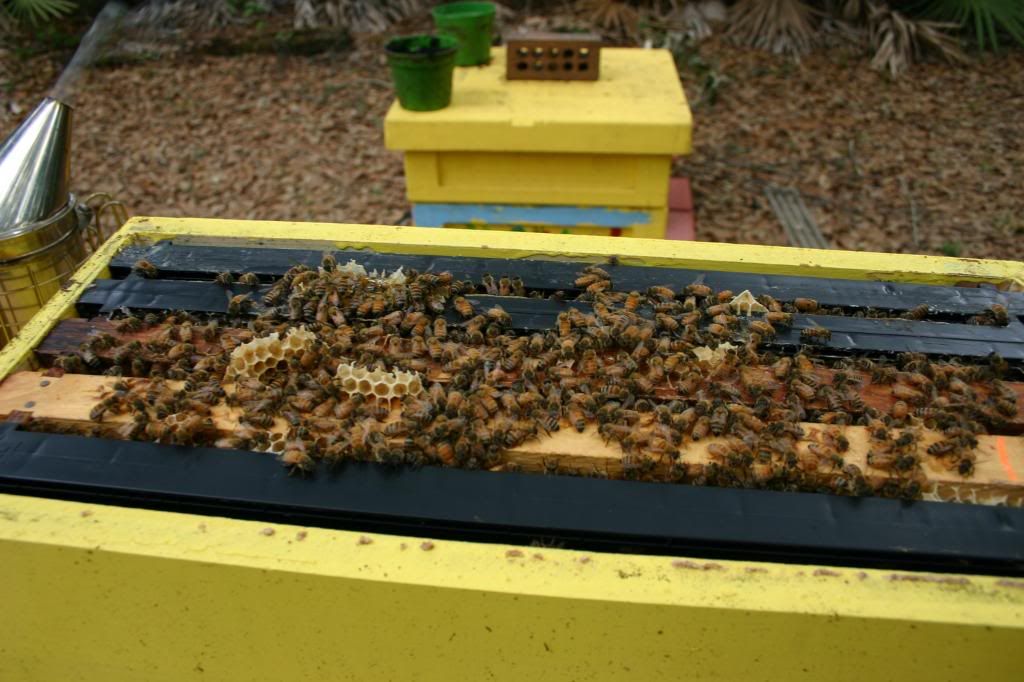 Right now all the bees that came with the split are foraging, and all the Australian bees are doing the inside work. My guess is that in less than two months the local bees in the TBH will die off, and the Australians will completely populate this hive. I replaced the top of the Nuc with a top that has zero clearance between the frames and the cover. There was too much burr comb being built in the space. I’m doing anything I can think of to make it as uncomfortable as possible to encourage the bees to move down.
 I noticed one thing today on my inspections. The small hive beetle trap was full as usual in my main hive, but there were no beetles to be seen in the TBH. I could only guess why at this point.
Sunday, April 13, 2008
Busy Apiary
Sunday, April 6, 2008
Redirect Traffic on the TBH
I’ve been somewhat disappointed in the lack of interest the bees have shown on the cavity of the TBH. Observations in the window were rather uneventful. Usually 3 or 4 bees exploring the wax I used to install the starter strips.
Saturday I decide to take drastic measures. I closed the Nuc’s entrance, and forced traffic to have to redirect down into the TBH’s entrance.  There was a huge jam for 10 minutes were the Nuc’s entrance used to be. Eventually a couple of bees found the new entrance, began fanning, and traffic resumed in and out via the TBH entrance. Inspection today (looked into the observation window) revealed several dozen bees showing interest in the 1st bar inside the TBH
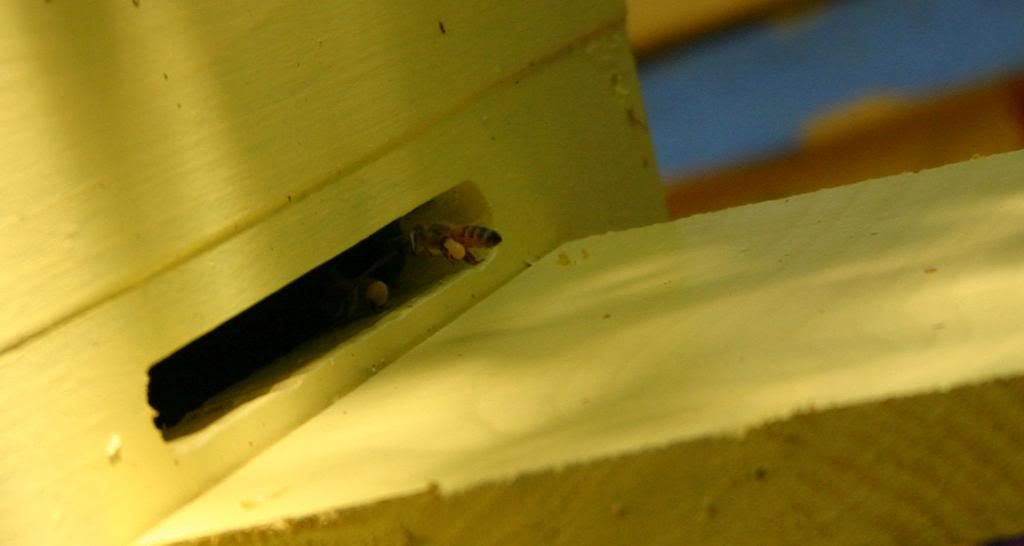
I rather this group wouldn't waste too much time, energy, or resources building up the nuc. I would like to use the nuc and the drawn out frames to kick start my packages due at the beginning of May.
Two Steps Forward, One Step Back
My aspiration is to one day run three functioning hives (2 langs, the TBH, and a NUC maybe two). Three weeks ago I split my hive in the hopes that I could begin my goal. As I moved forward; I may inadvertently slightly slowed progress.
Last week I found an uncapped supercedure queen cell. A supercedure cell is the way a hive replaces a failing, sick, old, or injured queen. That means the old queen is still around. How do I know the old queen is around?? There are 4 to 5 day old larvae. Not much but there are some.
Since I wasn’t sure of what to do, I spend the week reading and informing myself. I used the beekeeping forums and a Florida beekeeper got in touch with me to offer his advice. All in all, a great bunch of helpful people. There are definitely many ways to skin this cat. Meaning there are many paths to being a successful beekeeper, and to mess things up. Was the queen injured during the split???? By removing so many eggs and brood, and breaking up the brood nest did the bees think that the current queen was failing???????
Who knows for sure! Right now the cause is rather useless. The facts are the hive has four queen cells and I find myself referencing the bee math once again (last year for the 1st time). The pictures below show both sides of the same frame and a queen cells on each side. The location of the queen cells makes them supercedure cells. Swarm cells would be located at the bottom of the frame.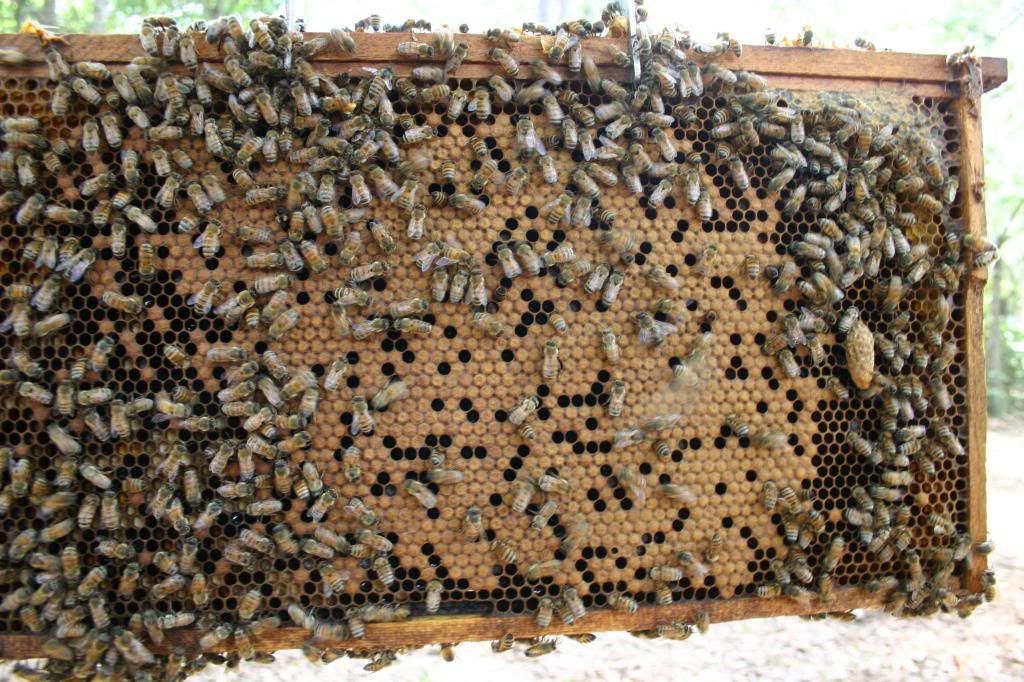 (Above Queen cell to the right)
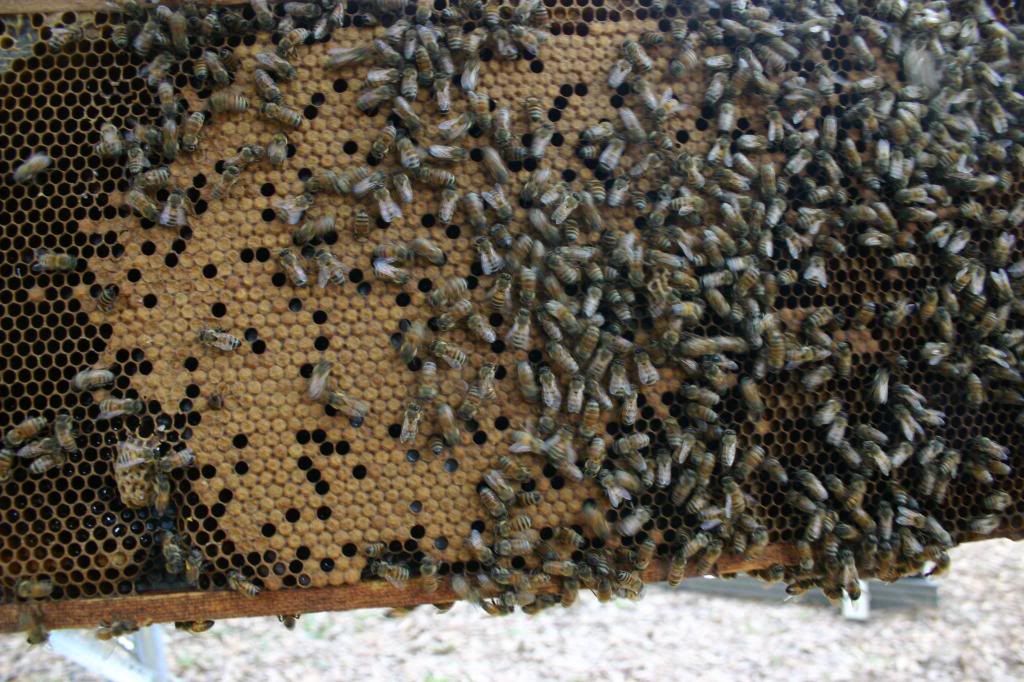 (Above Queen cell to the left)
In about 16 days one queen will hatch, kill the un-hatched queens, fly out to mate, and eventually take over the hive. I will leave the hive alone for 20 days, and hopefully an inspection by then will reveal new eggs from the new queen.
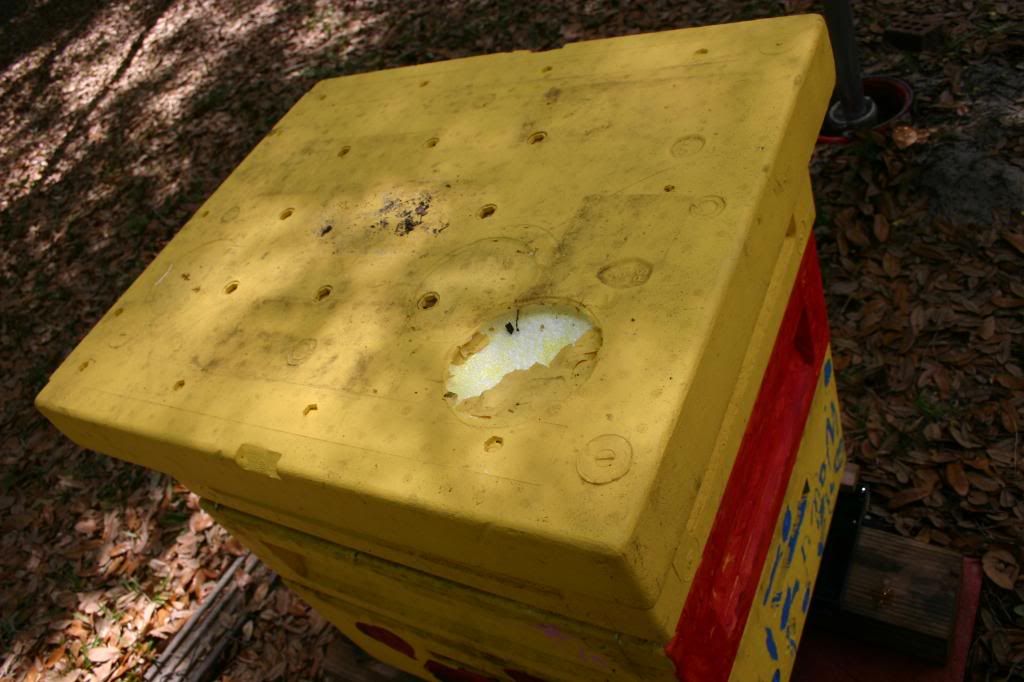
PS. when it rains, it poures. I don't know what I was thinking when I placed my hot smoker on the Beemax top. Some fiberglass resin should fill the hole nicely